Sizing
What Size Dumpster Do I Need? A Dallas Homeowner's Guide
Quick answer: a 20 yard fits most Dallas renovations. Here is how to pick between 10, 15, 20, 30 and 40 by counting pickup loads and watching the weight.
Read the guideGuide · 10 min read
If you have never rented a dumpster, this is the page to read first. It covers the whole process from the phone call to the pickup, with the Dallas and DFW specifics that national guides leave out.
You call, describe the job and the address, and get a flat price that covers delivery, a 7-day rental, pickup and disposal up to a stated tonnage. The truck delivers an open-top container to your driveway, lot or job site, you load it level with the top rail, and you call when it is full. Pickup is usually next day. Same-day delivery is routine in Dallas and the southern suburbs when you call before noon.
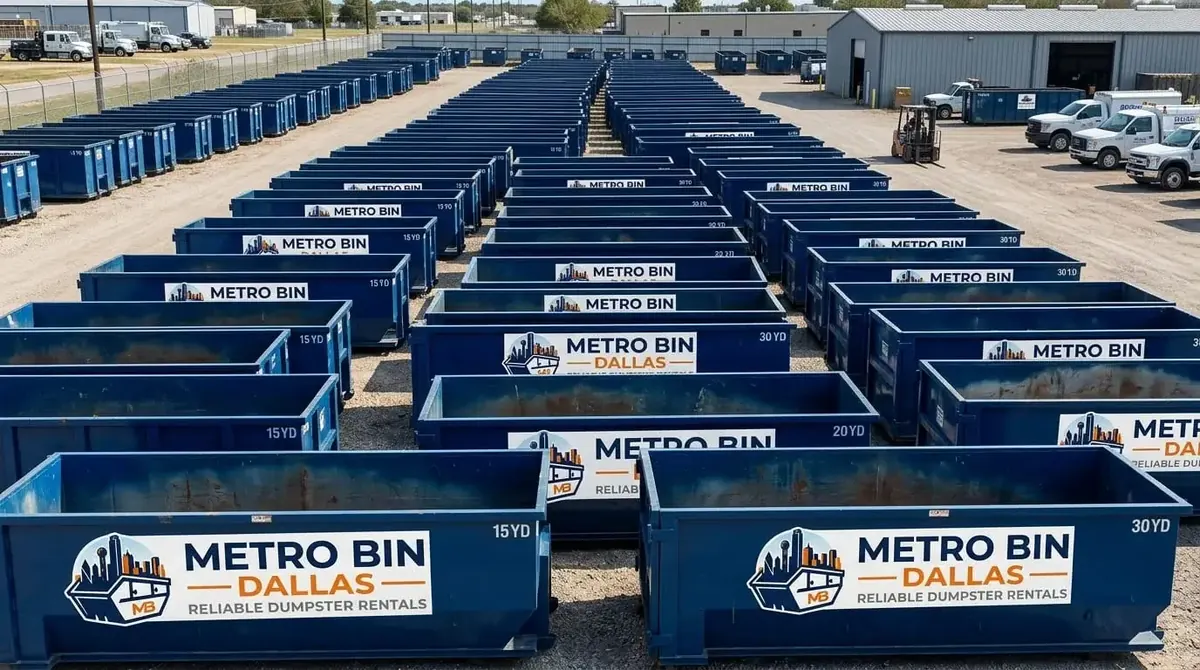
Count the job in pickup loads — about 3 for a 10 yard, 4–5 for a 15, 6 for a 20, 9 for a 30, 12 for a 40 — then check the weight. Concrete, brick, shingles, soil and tile fill a container's tonnage long before it looks full, so they go level in a 10. Everything else is a question of driveway length: 25 feet for a 10, 35 feet for a 20 or 30, 40 feet for a 40. The sizing guide has the full table.
The City's Department of Sanitation serves single-family homes and duplexes exclusively — trash, recycling, and brush and bulky items once a month up to 10 cubic yards, set out behind the curb and never in the street. Its Brush and Bulky page is explicit about what it will not take: building materials, bricks, rock, asphalt, gravel, concrete, roofing, dirt, soil or sod, and "waste generated from projects requiring the use of a contractor should be disposed of by the contractor." The City provides no dumpster or roll-off service at all; commercial, industrial and multi-family properties must use a franchised private hauler.
Household hazardous waste — paint, chemicals, oil, batteries — goes to the City's Home Chemical Collection Center at 11234 Plano Road (214-553-1765), which several suburbs also use.
On your own driveway or lot we found no City permit requirement. Boards go under the rails as standard. In a street, alley or sidewalk the City treats a container as occupying the right-of-way: Chapter 43 requires a Public Works permit for construction in the right-of-way and assumes a timed permit for occupying a street for building purposes, and the Right-of-Way Management office (214-948-4290) issues right-of-way and traffic control permits through its online system. A lane closure needs a traffic control plan. The code does not name dumpsters; this is simply the office that handles them.
Dallas requires any private solid waste hauler to hold a City franchise under Chapter 18 of the City Code — Sec. 18-32 makes operating without one an offense, Sec. 18-29 defines a collection bin to include a roll-off box, and the franchise is non-exclusive with a fee of at least 6% of gross receipts. The Sanitation Franchise Unit (214-670-3111) keeps the list of franchisees, and the City tells property owners to verify their hauler is on it.
Beyond the city line the rules diverge sharply. Irving excludes construction haulers from its franchise rule; Carrollton issues an open permit; Garland, Grand Prairie and Cedar Hill grant franchises; Richardson permits construction haulers; and Plano, Frisco, McKinney, Allen, Lewisville, Mesquite, Arlington, Rowlett and DeSoto reserve roll-offs to their contracted hauler. The city-by-city guide quotes each one, and every city page says what applies there.
In: household junk, furniture, construction debris, yard waste, roofing, metal, cardboard, and concrete, brick or tile loaded level in a 10. Out: paint, solvents, fuel and oil, propane, pool and lawn chemicals, batteries, tires, electronics, medical waste and asbestos. Fridges and air conditioners need the refrigerant removed first. Texas requires an asbestos survey and a notice to the Department of State Health Services at least 10 working days before demolition of a public or commercial building, so a demolition job starts with that question. The full guide says where each banned item goes instead.
Load level with the top rail — an over-full container cannot be transported safely or legally and the driver will have to leave it. Distribute heavy material across the floor rather than at one end. Keep the path clear for pickup; you do not need to be home. Call or text before the pickup date if you need more time, and before the load goes over the weight line if you think it might — a planned second haul is cheaper than a surprise.
Call (214) 239-1274, 24 hours a day, 7 days a week. Have the address, the material and a rough quantity ready. You will have a flat price and a delivery window before you hang up.
Talk to a real person
Call (214) 239-1274 with the address and what is going in. A flat price and a delivery window before you hang up.
Open 24 hours, 7 days
From this guide
7 days as standard, with daily extensions. Call or text before the pickup date.
No. The City provides no dumpster or roll-off service and tells commercial properties to use a franchised private hauler. It collects residential brush and bulky items once a month.
Yes — book it and call for pickup when it is full. The flat price covers up to 7 days whether you use them or not.
Yes, across the metroplex, with the hauling rules of each city stated on its page.
Keep reading
The rest of the series, same approach — official sources, no filler.
Sizing
Quick answer: a 20 yard fits most Dallas renovations. Here is how to pick between 10, 15, 20, 30 and 40 by counting pickup loads and watching the weight.
Read the guideCity rules
Dallas has no driveway permit and a right-of-way office for street placements — but across DFW the bigger question is which cities reserve roll-offs to their own hauler. Every city we serve, from its own code.
Read the guidePricing
Typically $350 to $750 flat rate in Dallas, depending on size and material. What is in the number, what adds to it, and how to keep a job inside the quote.
Read the guide